

Volkskapital
A new Myth combining the Myth of the Market and the Myth of the People
Lecture at 2026th International Conference on Critical Applied Psychology - ICCAP: Capitalism, Crisis, Criique & Change, University of Innsbruck J
July, 14, 2026
Let me begin with a claim that sounds strange. We usually think of myth as something old. Gods, heroes, rituals. Something we have left behind. And we think of modern economic reasoning as the opposite of myth. It speaks the language of science. Of logic, evidence, proof. I will argue that this opposition is an illusion. The neoliberal concept of the market, as our culture imagines it, is a myth. Not a falsehood, not a fairy tale — a myth in a precise, structural sense. And it shares its structure with something that seems its very opposite: the myth of the people, the thinking of the far right.
To show this, I use a single analytic instrument. Seven characteristics of mythical thought. I take them from the philosophy of myth — above all from Ernst Cassirer and Kurt Hübner. I first calibrate them on the archaic myth, the world of Homer and the gods. Then I apply the same seven, unchanged, to two modern cases: the myth of the people, and the myth of the market. The table before you is the result. Three columns, one instrument. Let me walk you through the seven rows, and then draw the conclusion that matters, it is set out in the last column.
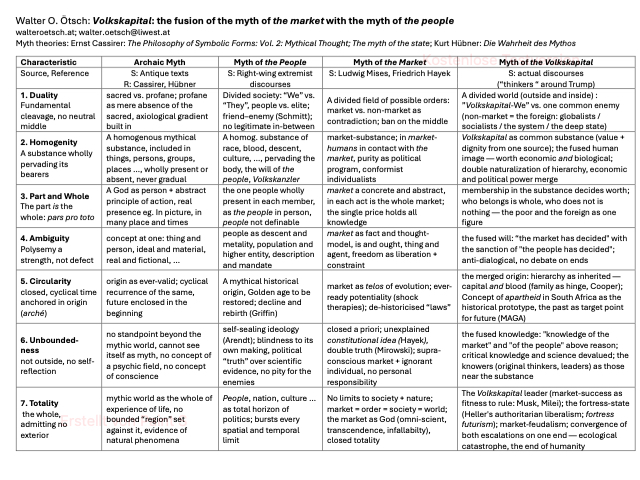
The first characteristic is duality. Every myth begins by cutting the world in two. In archaic myth, the cut runs between the sacred and the profane — and the profane is not a second thing, it is simply the place where the sacred is absent. In the myth of the people, the cut runs between the people and its enemy — We against Them: the elite, the system, the foreign. Carl Schmitt gave this its sharpest form: friend and enemy. In the myth of the market, the same cut returns, now as a logical contradiction. Market against non-market, as I call it. “Either capitalism or socialism,” writes Mises, “there is no middle thing.” Notice: this is not an empirical finding. History is full of middle things. It is a prohibition. The middle must not exist, because the whole doctrine rests on its impossibility. Three contents, one operation: a world split in two, with no neutral ground.
The second characteristic is homogeneity. Once you cut the world in two, each half must be uniform. And myth makes it uniform by filling it with a divine substance — a force that wholly pervades its bearers. In archaic myth, this substance clings to a thing, a person, a tribe, a place, a bloodline. In the myth of the people, it is blood, descent, the racial or cultural essence that flows through every member. In the myth of the market, it is a uniform process of exchange — with a single logic, single forces, single 'laws': the market-substance itself, establishing a field of efficiency and freedom. In that, according to Hayek, humans react unconsciously and automatically to price signals.
And here the two modern myths reveal something precise. The one makes all people equal through descent. The other makes all people equal through the way they must respond to a higher-level process. Opposite in content. Identical in operation. In both, the concrete, many-sided, historical human being is subjected to something higher that he/she cannot control.
The third characteristic is the relation of part and whole. In myth, the part does not represent the whole. It is the whole. A lock of hair, in archaic thought, is not a sign of the person — it carries the person's full reality. In the myth of the people, the single member is not a fraction of the nation. He or she is the nation, wholly present, in one body. And in the myth of the market? Mises writes that the market is “indivisible.” Every single act of exchange is not a piece of the market. It is the whole market, present at that point. And Hayek makes the boldest claim of all: the single market price carries the knowledge of the whole society. The part holds the whole. This is why a single intervention is felt as a wound to the entire order. Because in the part, the whole is present.
The fourth characteristic is the most surprising: ambiguity. Science strives for clear concepts. Myth does the opposite. Its central concept means many things at once — and that is the source of its power. The mythic concept is thing and person, fact and value, material and ideal, all at the same time – and real and fictional. And because it cannot be pinned down, it cannot be refuted. In the myth of the people, the people mean at once a population and a higher unity, a description and a mission. In the myth of the market, the market is at once a fact with its own laws and a mere thought-model. It is at once an is and an ought. It is at once an impersonal mechanism and an agent that acts, rewards, punishes. Above all, freedom in this thinking means at once liberation and submission. You are free, it says — free to obey the market. This ambiguity is not a weakness of the concept. It is its armour. Whatever objection you raise, the other meaning is always available.
The fifth characteristic is circularity — a closed, cyclical structure of time, anchored in an origin. The Greek word is archḗ: the beginning that is also the ever-valid. In archaic myth, time returns upon itself; the future is enclosed in the origin. In the myth of the people, there is a mythical origin and an golden age that must be restored — decline followed by rebirth. The historian Roger Griffin calls it palingenetic: the myth of national rebirth from decay. And in the myth of the market, the same time-structure governs. The market is the summit of cultural evolution — its origin gives it its dignity. It stands outside history; its “laws” hold for all times. And it is an ever-available potentiality: remove the obstacles, and it will appear, as it always could have. This is why the market can be imposed anywhere, at any moment – this has been practised, as many shock therapies have shown. The future is not a task to be shaped. It is a destiny to be obeyed.
The sixth characteristic is unboundedness — and this one carries the heart of the argument. A myth has no outside. No standpoint beyond itself, from which it could examine itself. And because it cannot see itself from outside, it cannot recognise itself as myth. In archaic thought this is simply the condition of living wholly inside the mythic world. In the modern myth of the people, Hannah Arendt described it exactly: the self-sealing ideology, which translates every fact that contradicts it into its own language before the fact can speak. And in the myth of the market? Mises builds a closed system, a pure deduction that no experience can touch. And Hayek forbids reflection on the market as a whole — he calls it the “abuse of reason”. But he himself assesses the whole of the market and at the same time cannot reflect on the fact that his own approach rests on a concept that did not arise spontaneously, but that he himself conceived. He lacks the one standpoint from which the thought-form could recognise what it is. And because he lacks it, the market myth takes itself, undisturbed, for science.
The seventh characteristic is totality. The myth is not one region of the world beside others. It is the whole. In archaic thought, the mythic world is the whole of experience; there is no neutral zone set against it. In the myth of the people, the nation becomes the total horizon of all politics — and it bursts every boundary, spatial and temporal. And in the myth of the market, market, society, and world become one in the concept of the order. Economics becomes the master-science, the science of everything, because everything is market. A university is a market. This conference is taking place in the marketplace of ideas.
And at the summit, the market takes on the features of a god. Transcendence: it stands above men and above time – Hayek uses this term. Omniscience: it knows what no single mind can know. Infallibility: its verdict is right by definition, and where it seems wrong, man has erred, never the market. Before such a being, only one posture remains — the posture Hayek demands, and calls humility.
Now — the conclusion. Look at the three columns together. The contents could not be more opposed. But the form is the same. It describes the same form of the thinking itself — beneath what is thought, in how it is thought. This is not a comparison. It is a proof. Identity of form, not of content.
My thesis is: The actual dominant cultural myth stems from a historical fusion of the myth of the people and the myth of the market, as Quinn Slobodian shows in Hayek’s Bastards. Volkskapital names the point at which these seemingly opposite myths prove to be one. Volkskapital is the substance of that fusion: a single essence from which both economic worth and ethnic belonging are held to flow.
The fusion works because each myth already treats the human being as a bearer of pervading substance — for the one it is blood, for the other market-essence. In Volkskapital these merge: a person's value (as capital, as measurable performance, e.g. by IQ) and their dignity (as descent, as membership) become indistinguishable. Worth is naturalised twice over, economically and biologically.
Important implications of this thesis are:
First, a double naturalisation of hierarchy. The poor and the foreign become a single figure — the one who does not belong. Inequality is placed beyond criticism, since one cannot protest against an essence.
Second, a merged human image and a merged knowledge: “the market” and “the people” both stand above reason, and critical or scientific knowledge is devalued as the arrogance of the elite or the abuse of reason. Facts stop having a definitive meaning. Who cares that yesterday was the opposite of today?
Third, new political forms. Business and politics are getting closer. The merged will („the market has decided“, „the people have decided“) is anti-dialogical, executed by the leader. The leader combines market success with the right embodiment; the state becomes a fortress — weak against capital, hard against the enemy within and without, and loot for the leader, his family and friends.
Fourth, and gravest: In both myths there is a built-in spiral of escalation; in Volkskapital it is intensified. The total logic of the people drives toward authoritarian rule; the total logic of the market toward the ever-deeper economisation of life, with an accelerating inequality of wealth.
They are on a common path — into the erosion of democracy and into an ecological catastrophe.
The task of the critical sciences is to decisively oppose this development.